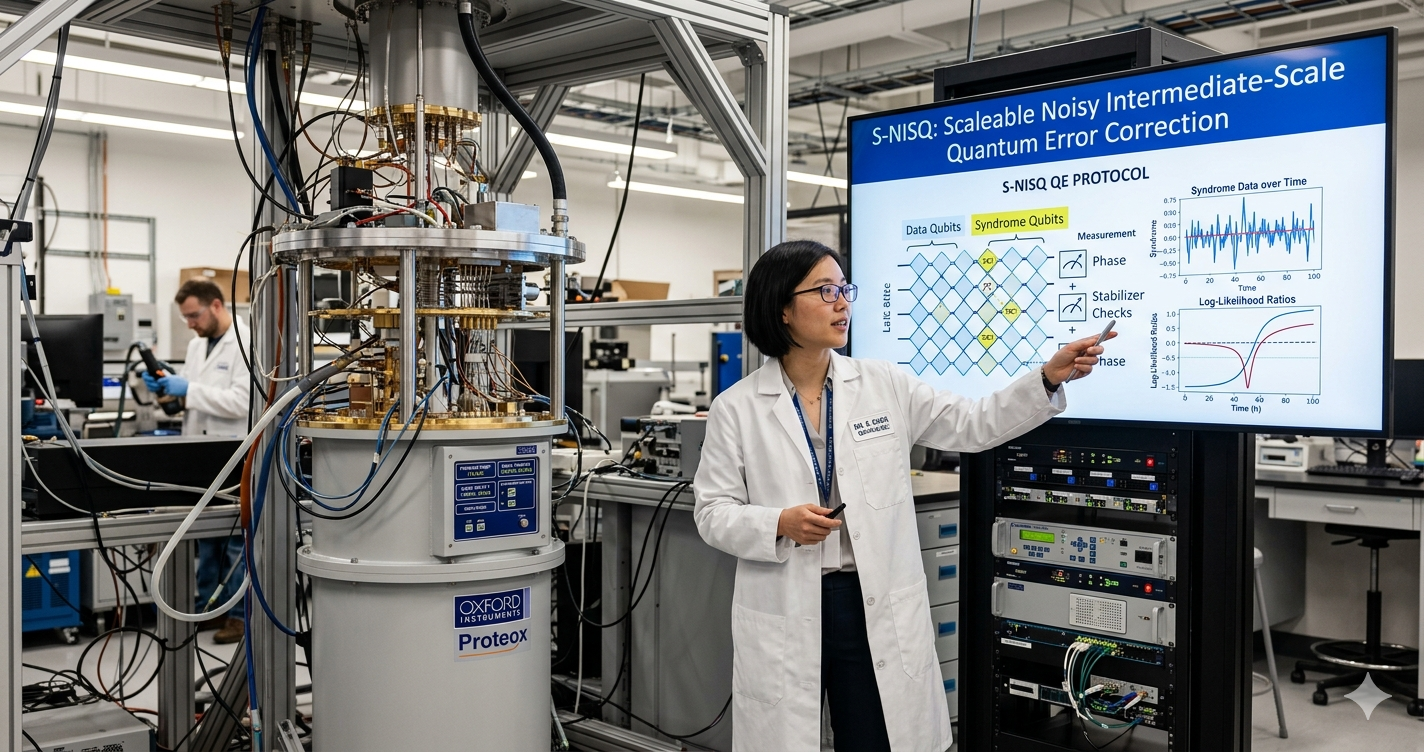

s-nisq quantum error correction often feels like standing at the edge of a technological frontier—full of promise, yet surrounded by uncertainty. Among the many challenges shaping this field, error management remains one of the most critical. This is where s-nisq quantum error correction enters the conversation, offering a practical and evolving approach to stabilizing quantum systems in today’s imperfect hardware landscape.
Unlike classical computers, quantum machines are incredibly sensitive. A slight disturbance—thermal noise, electromagnetic interference, or even measurement itself—can distort calculations. As researchers push forward in what is known as the Noisy Intermediate-Scale Quantum (NISQ) era, s-nisq quantum error correction is becoming a key concept that bridges theoretical perfection and real-world feasibility.
Understanding s-nisq quantum error correction and its Foundations
To truly appreciate s-nisq quantum error correction, it helps to first understand the environment it operates in. NISQ devices are quantum computers with tens to hundreds of qubits, but without the robustness required for fully fault-tolerant operations. They are powerful yet fragile—capable of performing certain computations faster than classical systems, but prone to errors at every step.
Traditional quantum error correction methods demand thousands—or even millions—of physical qubits to protect a single logical qubit. This requirement is far beyond the capabilities of current machines. That’s why s-nisq quantum error correction focuses on scalable, simplified, and hardware-aware strategies that work within today’s limitations.
Rather than aiming for perfect correction, it emphasizes error mitigation and partial correction, allowing useful results even when noise cannot be entirely eliminated. This shift in philosophy has reshaped how researchers think about reliability, moving away from perfection and toward practicality.
Why s-nisq quantum error correction Matters Today
The importance of s-nisq quantum error correction lies in its practicality. While fully fault-tolerant quantum computing may still be years or even decades away, NISQ devices are already being used for research in chemistry, optimization, and machine learning.
However, without reliable error handling, their outputs can quickly become unreliable. This is where s-nisq quantum error correction proves essential. It enables researchers to reduce computational noise without massive overhead, extract meaningful signals from imperfect systems, and extend the usability of current quantum hardware.
In essence, s-nisq quantum error correction transforms today’s limited machines into tools that can still generate valuable insights, even under imperfect conditions.
Core Techniques Behind s-nisq quantum error correction
The strength of s-nisq quantum error correction lies in its adaptability. Instead of relying on one rigid framework, it incorporates a range of techniques designed to minimize and manage errors efficiently.
Error Mitigation Instead of Full Correction
One of the defining features of s-nisq quantum error correction is its reliance on error mitigation. This involves running circuits multiple times, analyzing noise patterns, and mathematically adjusting results to approximate ideal outputs.
For example, if a quantum circuit consistently produces slightly skewed results, mitigation techniques can reverse-engineer the noise and correct the final outcome statistically. This makes s-nisq quantum error correction highly practical for current systems.
Shallow Circuit Design
Another approach within s-nisq quantum error correction is minimizing circuit depth. The longer a quantum circuit runs, the more errors accumulate. By designing shorter, optimized circuits, researchers reduce exposure to noise.
This strategy doesn’t eliminate errors entirely, but it significantly lowers their impact and enhances overall reliability in NISQ devices.
Noise-Aware Algorithms
Algorithms used in s-nisq quantum error correction are often tailored to the hardware they run on. Instead of assuming a perfect system, they account for known noise characteristics and adapt accordingly.
This alignment between software and hardware is a hallmark of the NISQ philosophy, ensuring that performance is optimized for real-world conditions rather than ideal scenarios.
Hybrid Quantum-Classical Methods
A key pillar of s-nisq quantum error correction is the integration of classical computing. Quantum processors handle complex state calculations, while classical systems refine, verify, and correct outputs.
This collaboration enhances accuracy without requiring additional qubits, making s-nisq quantum error correction both efficient and scalable.
Challenges Facing s-nisq quantum error correction
Despite its advantages, s-nisq quantum error correction is not without limitations. Its very nature—working within imperfect systems—means compromises are inevitable.
Limited Accuracy Gains
While s-nisq quantum error correction improves results, it does not guarantee perfection. Some errors remain unavoidable, especially in highly complex computations.
Resource Trade-Offs
Even lightweight correction methods require additional measurements, repetitions, or classical processing. Balancing these resources is a constant challenge in s-nisq quantum error correction implementations.
Hardware Variability
Quantum devices differ significantly in architecture and noise profiles. Techniques that work well on one machine may not perform as effectively on another, making s-nisq quantum error correction highly context-dependent.
Real-World Applications of s-nisq quantum error correction
The practical nature of s-nisq quantum error correction has opened doors across several domains, where even imperfect quantum results can provide value.
Quantum Chemistry Simulations
In molecular modeling, small inaccuracies can still lead to meaningful predictions. By applying s-nisq quantum error correction, researchers can simulate chemical interactions more reliably than with raw, noisy outputs.
Optimization Problems
Industries such as logistics and finance benefit from optimization algorithms. Even approximate solutions can be valuable, and s-nisq quantum error correction ensures those approximations remain consistent and useful.
Machine Learning Enhancements
Quantum-enhanced machine learning models rely on stable outputs. With s-nisq quantum error correction, these models can train and adapt despite underlying hardware noise.
The Future of s-nisq quantum error correction
Looking ahead, s-nisq quantum error correction is expected to evolve alongside quantum hardware. As qubit quality improves and new architectures emerge, these techniques will become more refined and effective.
Researchers are exploring adaptive correction methods, AI-driven noise modeling, and improved hybrid systems. Each advancement brings us closer to bridging the gap between noisy quantum devices and fully fault-tolerant systems.
Conclusion
At its core, s-nisq quantum error correction represents a pragmatic approach to one of the hardest problems in quantum computing. Instead of waiting for perfect machines, it empowers us to make the most of what we have today.
By embracing imperfection and working around it, s-nisq quantum error correction is helping unlock the true potential of NISQ devices. It stands as a reminder that progress in technology is often not about eliminating limitations entirely, but about learning how to navigate them intelligently.